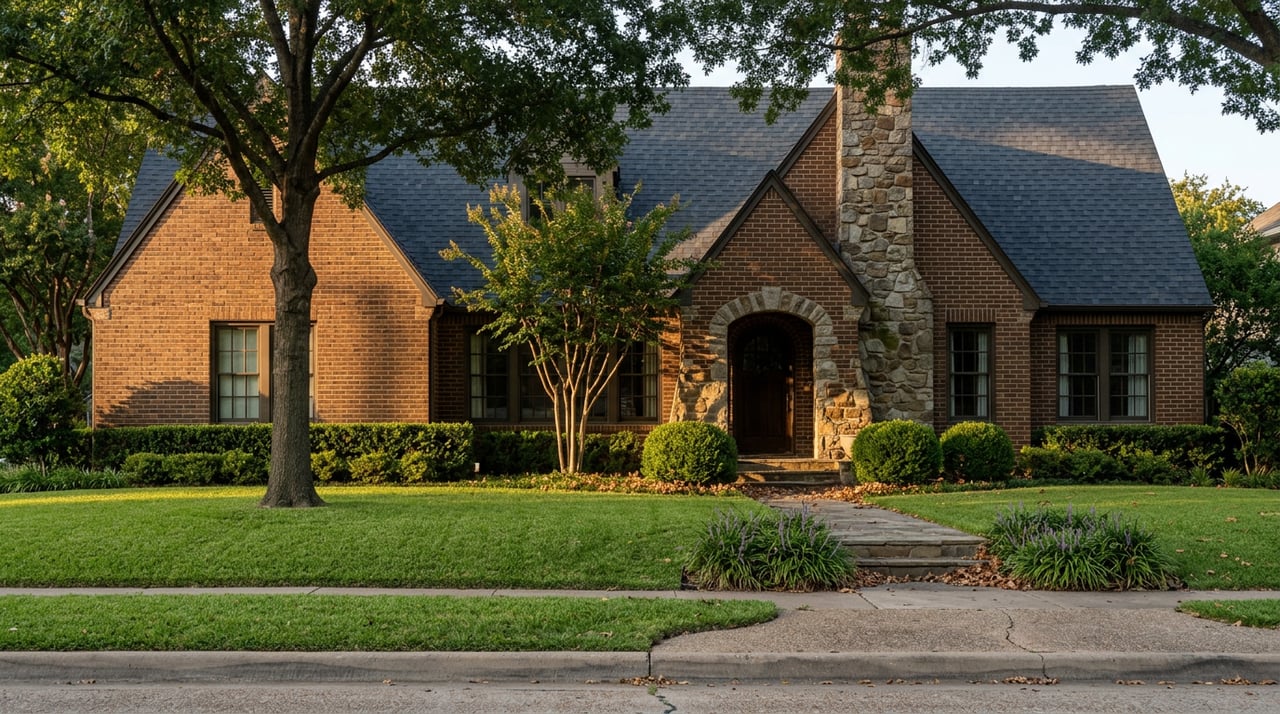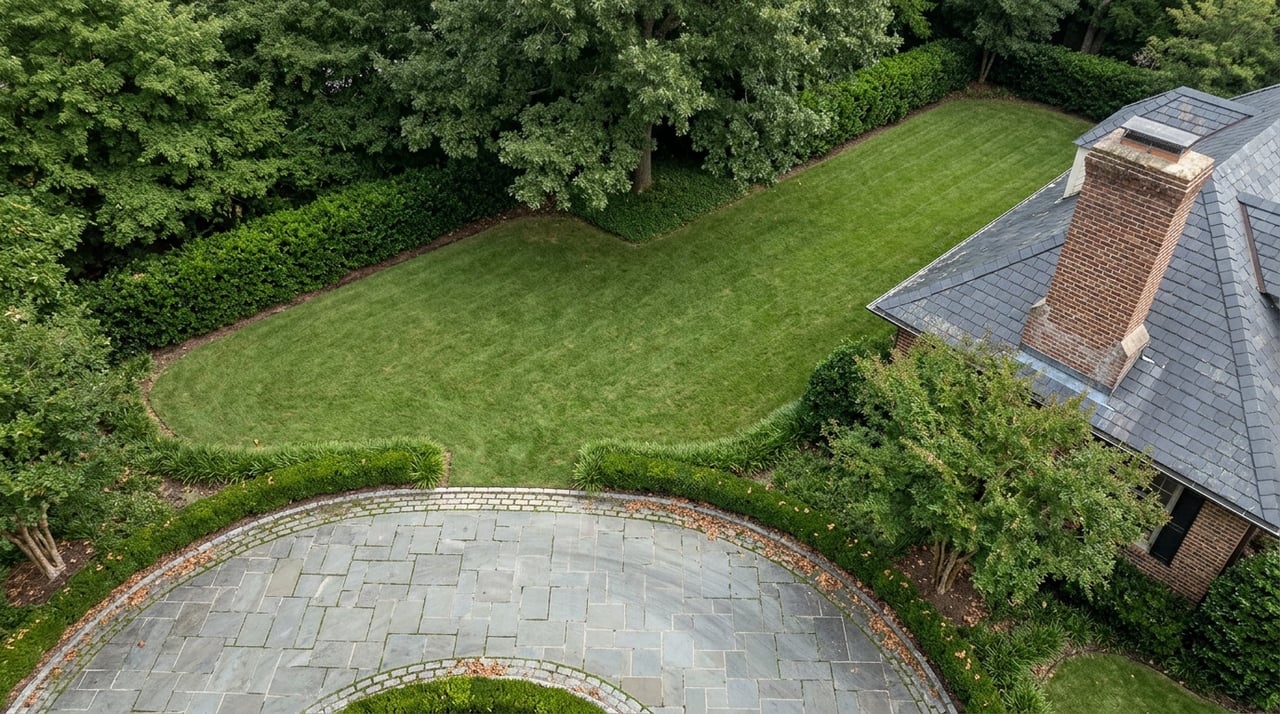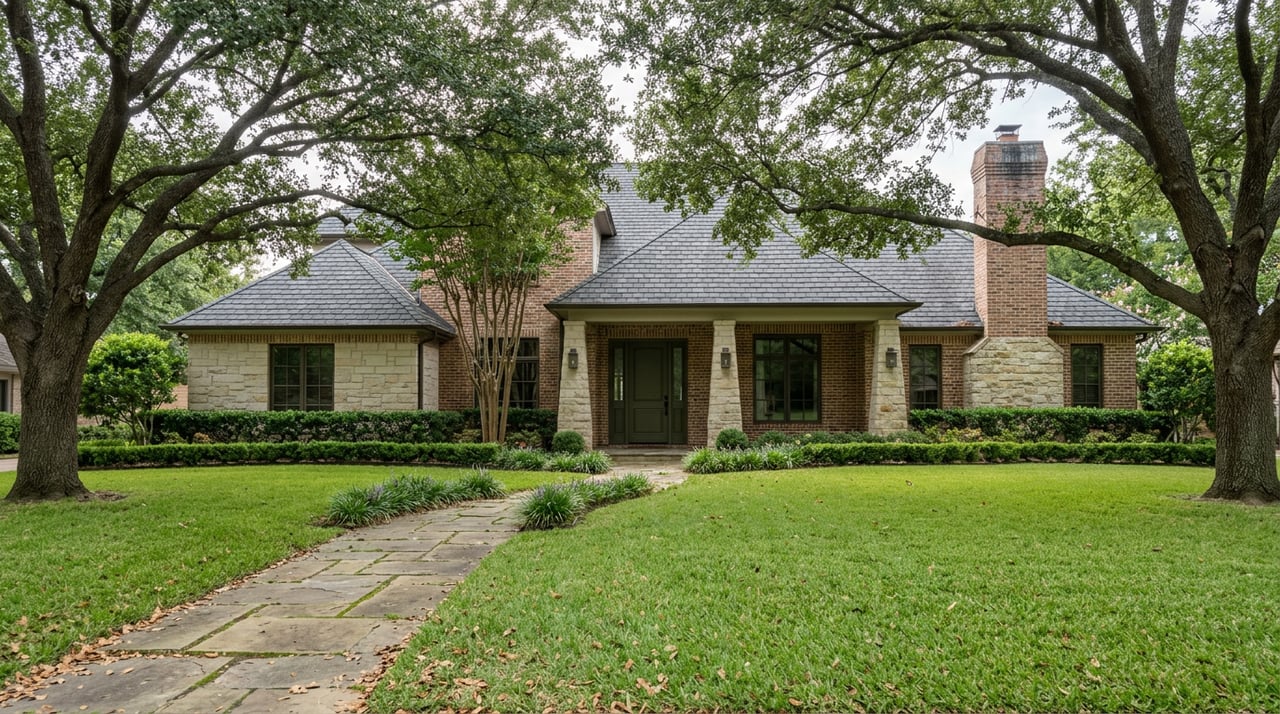
Walk along Nakoma Drive on a weekday evening and something looks off if you grew up on a normal Dallas block. Half the houses seem to be facing the wrong way. Porch lights aren't angled toward the driveway. They're angled toward a strip of lawn and old oak canopy running behind the property line, not in front of it.
That's not a construction quirk from the 1930s. It's the entire premise of the neighborhood.
Greenway Parks was laid out in 1927 by architect David R. Williams, and the homes built through the 1940s were designed with their front doors facing the greenbelt instead of the street, following the "English commons" tradition Williams borrowed for the plan. The street was never meant to be the address that mattered. The shared park behind the house was the point.
Almost a century later, that reversal still shapes how people here spend their evenings, and it's the detail most write-ups of this neighborhood skip on their way to talking about square footage.
Eight Greenways, Not One Park
The word "park" in Greenway Parks isn't marketing shorthand. It's a plural, and a specific one. Eight named greenways run east-west through the neighborhood, threading between houses along Mockingbird, Montrose, Waneta, Nakoma, and Wenonah. Two triangular parks bookend the whole layout, marking the entrances at University Boulevard to the north and Mockingbird Lane to the south.
Together, this system of privately owned, commonly held parkland covers about 23 of the neighborhood's 150 acres, according to its National Register of Historic Places certification. Fewer than 300 homes share that acreage. Put another way, roughly one-sixth of the entire footprint of Greenway Parks belongs to no single owner. Nobody can fence it, subdivide it, or landscape it to their own taste. It's held in common and maintained by the homeowners association as a single connected system, not a handful of scattered pocket parks.
That's a different proposition than a nearby city park you drive to on a Saturday. This is park land woven directly into the walk between your kitchen and your neighbor's.
Why the Front Doors Face the Park
The developer's sales pitch in 1927 called it, in the words the Greenway Parks Homeowners Association still quotes from that year's Dallas Morning News coverage:
The evolution of a wholly modern idea, one strikingly unique and the first exclusive residential section of its kind ever opened in the South.
Williams, later known as the father of Texas Modernism, wasn't just landscaping around houses. He was rearranging where a house's social front actually sat. Homes built through the neighborhood's first two decades have their front doors and porches oriented toward the greenway, not the pavement, a design choice Preservation Dallas still cites as one of the district's defining features.
The practical effect, even now, is that a lot of daily neighborhood contact happens across shared lawn rather than across a sidewalk facing traffic. Kids cut through the greenbelt to reach a friend's yard instead of walking the long way around the block. Neighbors talk across the parkway, not across a driveway.
Small Signs This Is Still a Working System
A neighborhood built on a 1927 plan could easily have calcified into something preserved behind glass. The evidence says otherwise. As People Newspapers reported in 2023, the greenway entryways now have dog waste-bag stations installed at the access points, a distinctly unglamorous, distinctly modern addition to a nearly hundred-year-old commons. You don't add trash infrastructure to a park nobody uses.
The same pattern shows up in how the neighborhood marks its calendar. The central triangular park serves as the gathering point for a Fourth of July tradition that still draws kids riding bikes and residents decorating golf carts for a short neighborhood parade. It's a small-scale event, sized to a neighborhood of under 300 homes, but it only works because the park space to gather in already exists and has existed since the plan was drawn.
When the Greenbelt Isn't Enough
The private greenways aren't built for organized sports or splash pads, and residents don't pretend otherwise. Germany Park, just outside the neighborhood boundary near the Tollway, picks up the slack with the John Roach Track and tennis courts. On hot months, families head to the K.B. Polk Sprayground and the adjacent recreation center for the kind of high-heat relief a shaded parkway can't provide.
That division of labor matters. The greenways handle the daily, low-key stuff, the dog walk, the after-dinner stroll, the kids cutting through on bikes. The nearby public parks absorb the higher-intensity uses. Neither system is trying to do the other's job.
The Friction Point Nobody Papers Over
None of this is frictionless. Guides to the neighborhood note a real complaint from residents: the same narrow paths that make the greenways feel intimate also put cyclists and families walking dogs or pushing strollers in tight quarters, and not everyone shares the space graciously. It's a small irritation, not a crisis, but it's worth naming because it's the kind of detail that only surfaces from people who actually use the paths, not from anyone describing the neighborhood from a listing photo.
What Holds the System Together
None of this survives by accident. In May 2003, the City of Dallas designated Greenway Parks as Conservation District No. 10, which locks in exterior design standards specifically to protect the neighborhood's physical character, greenways included. Five years later, the district was entered into the National Register of Historic Places, one of only 24 such districts in the city, a designation that formally recognizes the 23 acres of shared parkland as a defining architectural feature, not an incidental amenity.
That combination, a private HOA that actually maintains the land day to day and a city-backed conservation designation that prevents piecemeal erosion of the plan, is why the greenways still function the way Williams drew them in 1927. Plenty of Dallas neighborhoods have old trees and quiet streets. Few have a legal and financial structure built specifically to keep a shared park system intact for a century.
If you already live here, none of this is news exactly. You've walked the dog past the waste-bag station at the greenway entrance. You've watched the golf carts get decorated for the Fourth. What might be new is seeing the whole pattern connected: the front doors facing the wrong way, the acreage nobody can subdivide, the modern additions to a century-old plan. It's not nostalgia keeping this neighborhood distinct. It's a specific, still-active piece of infrastructure that most people walk through without naming it.
If you're weighing a move within the neighborhood, thinking about how a renovation interacts with the conservation district's standards, or just curious what a home facing the greenbelt is actually worth compared to one that doesn't, The Ryan Group knows this stretch of Dallas at the level these details require. Schedule a free consultation when you're ready to talk specifics.